How Real-Time Voice AI Actually Works (STT → LLM → TTS Explained)
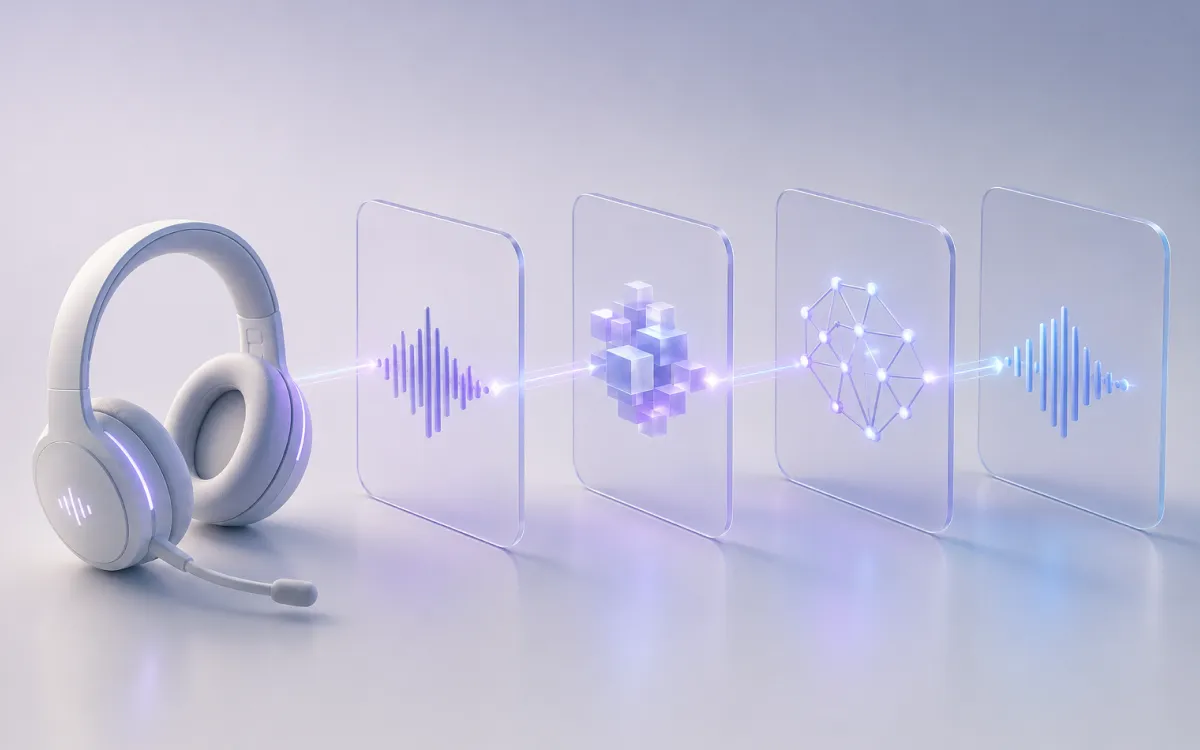

When you talk to a modern AI voice agent and it answers naturally in under a second, it feels like magic — but it’s actually a tightly engineered relay race between three systems running in real time.
Understanding how voice AI works isn’t just trivia for engineers; it’s the difference between buying or building an agent that feels human and one that feels like a laggy robocall. This guide breaks the whole thing down in plain English: the STT → LLM → TTS pipeline, where the milliseconds go, what makes an agent sound human, and when it actually takes action on your systems.
It’s written for tech leads, product managers, and agencies building or evaluating voice AI. By the end you’ll understand exactly how voice AI works under the hood, why latency is the metric that makes or breaks the experience, and what separates a production-grade voice agent from a demo. No hand-waving — just the real architecture.
The Pipeline in Plain English
At its core, a voice agent does what a person does on a phone call: it hears, it thinks, and it speaks. The difference is that each of those steps is a separate piece of software, and they have to hand off to each other fast enough that the caller never notices the seams.
The flow is a loop: Audio in → Speech-to-Text (STT) → Large Language Model (LLM) → Text-to-Speech (TTS) → Audio out — and then it repeats for the next thing the caller says. STT is the ears (it turns your speech into text), the LLM is the brain (it reads that text, figures out intent, and decides what to say), and TTS is the mouth (it turns the response back into a natural-sounding voice). This STT LLM TTS pipeline is the backbone of every real-time voice agent on the market, NextLevel.AI included.
The whole point of real-time voice processing is that this loop completes fast enough to feel like a normal conversation. A person leaves only a couple hundred milliseconds of gap between speakers in natural dialogue; push that gap past a second and the conversation starts to feel broken. So everything in the pipeline is engineered to shave milliseconds. Let’s walk through each stage.
Step 1 — Speech-to-Text (STT)
Speech-to-text is the front door. The caller’s audio streams in, and a speech to text AI model transcribes it into text the rest of the system can work with. This sounds simple, but it’s where many agents quietly fail.
Accuracy is everything here, because the LLM can only act on what STT heard. A single misheard word can flip the meaning — “I can’t make Tuesday” versus “I can make Tuesday” — and the agent will confidently do the wrong thing. Good STT has to handle accents, background noise, phone-line compression, names, and numbers, all in real time. The leading providers in this space include Deepgram, Google, AssemblyAI, and OpenAI’s Whisper, each with different trade-offs between accuracy, language coverage, and speed.
Latency at this stage typically runs 100–300ms in real-world conditions. The key technique for keeping it low is streaming: instead of waiting for the caller to finish a whole sentence and then transcribing it, streaming STT transcribes continuously as the person speaks, so the text is nearly ready the instant they stop. That streaming behavior is essential to the sub-second feel of a good agent — batch transcription, which waits for silence before starting, adds dead air the caller will notice.
There’s a second subtlety that separates good STT from great STT: confidence and context. Strong systems don’t just output words; they track how confident they are in each one, and they use the conversation’s context to disambiguate. If a caller says a word that could be “fifteen” or “fifty,” the surrounding sentence and the question the agent just asked help resolve it correctly. The best implementations also handle domain-specific vocabulary — drug names in a clinic, street names in real estate, SKUs in retail — by being tuned or prompted with the terms they’ll actually encounter. This is why a generic transcription engine that scores well on clean podcast audio can still struggle on a real phone call: the conditions are harder, the stakes per word are higher, and the agent has no chance to “ask a human” what it misheard. Getting the front door right is foundational, because every downstream stage inherits its mistakes.
Step 2 — LLM Processing
Once the caller’s words are text, the large language model takes over as the brain. An LLM voice agent uses the model to interpret what the caller means, hold context across the conversation, and generate the right response — all according to instructions you’ve given it. This is what makes it a true natural language voice AI: it understands intent expressed in ordinary, messy human speech, not rigid keypad commands or fixed phrases. Understanding this stage is most of understanding how voice agent works at all, because it’s where comprehension and decision-making actually happen.
Those instructions live in the system prompt, which is effectively the agent’s personality and script rolled into one. The system prompt defines who the agent is (“a warm front-desk coordinator for Bright Smile Dental”), what it should and shouldn’t do, the questions it asks, and when it escalates. The same underlying model can be a dental receptionist, a real estate qualifier, or a support agent purely based on this prompt. The models doing this work are the familiar ones — GPT-4, Claude, and Llama among them — chosen for reasoning quality, speed, and cost.
LLM latency is usually the largest single chunk of the pipeline, commonly 300–800ms, because generating a thoughtful response takes more computation than transcribing or synthesizing. This is why model choice and prompt design matter so much: a bloated prompt or an oversized model adds delay the caller feels. Here too, streaming helps — the system starts converting the first words of the response to speech before the model has finished generating the whole thing, so the agent begins talking sooner. Managing this stage well is the heart of conversational AI technology.
Step 3 — Text-to-Speech (TTS)
The final stage turns the LLM’s text response back into audio. A text to speech AI engine synthesizes a voice that, in the best systems, is hard to distinguish from a human one. This is the part callers judge instantly: a warm, natural voice builds trust, while a flat, robotic one makes people ask for a human within seconds.
The quality leap here is the move from older concatenated TTS — which stitched together pre-recorded sound fragments and sounded stilted — to modern neural TTS, which generates speech from scratch with natural intonation, rhythm, and emotion. Leading neural TTS providers include ElevenLabs, Cartesia, and OpenAI’s TTS, and the gap between them and legacy voices is night and day. Latency at this stage typically runs 200–400ms, and as with STT, streaming is the trick: the engine starts producing audio for the first words while still synthesizing the rest, so the agent’s reply begins almost immediately.
Beyond raw naturalness, good TTS handles the details that make speech sound considered rather than read aloud: correct pronunciation of names and numbers, appropriate pauses, emphasis on the right words, and a consistent persona across a long call. It also has to pronounce things the way a caller expects in context — reading “$89/mo” as “eighty-nine dollars a month,” or a phone number in natural groupings rather than as a single long string. Subtle prosody matters more than people expect: a voice that’s technically clear but flat in rhythm still reads as “a machine,” while one with natural rise and fall earns the caller’s patience. This is why voice selection isn’t a cosmetic afterthought — it’s one of the first things a caller judges, and it sets the tone for whether they engage with the agent or immediately ask for a human.
Total Latency — Why It Matters So Much
Add the stages up and you can see the challenge: STT (100–300ms) + LLM (300–800ms) + TTS (200–400ms) could naively total well over a second — and a caller who hears a pause longer than about 1.5 seconds starts to feel the conversation is awkward or broken. Research on human conversation shows we normally leave only around 200ms between turns, so we’re acutely sensitive to delay. Voice AI latency, then, isn’t a vanity metric; it’s the single biggest driver of whether an agent feels human.
The target the best platforms aim for is end-to-end response under roughly 700ms, and the way they hit it is by not running the stages sequentially. Instead of waiting for each step to fully finish before starting the next, a well-built system pipelines them with streaming: STT streams text to the LLM as the caller talks, the LLM streams its response to TTS as it generates, and TTS streams audio out as it synthesizes. Done right, the agent can begin replying before it has even finished “hearing” the full question — which is how AI voice response time drops below the threshold of human notice. This streaming, overlapping architecture is the core of what makes an AI voice infrastructure feel real-time rather than walkie-talkie.
| Stage | Job | Typical latency |
|---|---|---|
| Speech-to-Text (STT) | Audio → text | 100–300ms |
| LLM | Text → decision + response | 300–800ms |
| Text-to-Speech (TTS) | Text → audio | 200–400ms |
| End-to-end target | Full loop, with streaming | under ~700ms |
What Else Makes a Voice Agent Sound Human?
Speed is necessary but not sufficient. Several subtler behaviors separate a natural agent from a fast-but-awkward one, and they’re a big part of how voice AI works in practice.
Backchanneling
In real conversation, listeners make small noises — “mm-hmm,” “right,” “got it” — that signal they’re following along. A good agent does the same, dropping in brief acknowledgments so the caller doesn’t feel like they’re talking into a void. Without backchanneling, even a fast agent feels cold and machine-like.
Interruption Handling
People interrupt — to correct themselves, add detail, or cut to the chase. A production-grade agent supports barge-in: if the caller starts talking while the agent is speaking, the agent stops, listens, and adapts, just as a person would. An agent that plows through its scripted sentence while the caller is trying to speak instantly breaks the illusion and frustrates everyone.
Turn-Taking
The hardest subtle problem is knowing when the caller has actually finished speaking versus just pausing to think. Get it wrong one way and the agent interrupts; get it wrong the other and it leaves an awkward silence. Systems solve this with voice activity detection (VAD) and smarter endpoint detection — distinguishing a mid-thought pause (“I’d like to book for… um… Thursday”) from a genuine end of turn. Good turn-taking is invisible when it works and glaringly wrong when it doesn’t, and it’s one of the clearest markers of a mature platform.
When Does the AI Actually “Take Action”?
A voice agent that only talks is a novelty; the value comes when it does things. That happens through function calls (also called tool calls). Once the LLM recognizes an intent — “I’d like to book Thursday at 2” — it can invoke an external function: checking a calendar’s availability, creating the booking, writing a record to your CRM, or firing off a confirmation SMS.
Crucially, this happens mid-conversation, in real time. The agent can say “let me check that for you,” call your calendar API, get the open slots back, and offer them — all within the same fluid exchange. That’s the bridge between a voice that sounds human and an agent that’s genuinely useful: it’s not just understanding the caller, it’s acting on their behalf against your real systems. A platform’s depth here — how cleanly it integrates function calls into the conversation flow, and how reliably it handles the API round-trips without stalling the dialogue — is what turns the STT → LLM → TTS pipeline from a clever chatbot into a working employee.
This is also where engineering discipline shows. A naive implementation freezes awkwardly while it waits for an API to respond; a well-built one covers the round-trip naturally (“one moment while I pull that up”), handles a slow or failed call gracefully, and never leaves the caller wondering if the line dropped. The agent also has to decide when to call a function versus keep talking, and how to confirm the result back to the caller clearly (“you’re booked for Thursday at 2 — you’ll get a text confirmation”). Done well, the action feels like a competent person quietly doing their job; done poorly, it’s where the illusion of competence collapses. The richness and reliability of this function-calling layer is, in practice, one of the biggest differentiators between platforms that look good in a demo and platforms that hold up in production.
How to Evaluate a Voice AI Platform Using This Knowledge
Knowing how voice AI works turns vague vendor demos into a concrete checklist. Once you understand the pipeline, you can ask the questions that actually predict whether an agent will hold up on real calls.
Start with latency, because it’s the metric everything else rides on. Don’t accept a headline number from a scripted demo; ask for end-to-end response time measured under load, on real phone lines, with interruptions — that’s the figure callers will experience. A platform confident in its engineering will let you test it live. Next, probe STT accuracy on your specific conditions: your industry’s vocabulary, the accents your callers have, noisy environments, and strings of numbers like dates and phone numbers. Then judge voice quality directly — listen to the neural TTS voices and ask whether they support the languages and tone your brand needs. After that, dig into turn-taking and interruption handling, because these are where immature platforms fall apart: try talking over the agent, pausing mid-sentence, and correcting yourself, and see whether it adapts like a person or stumbles. Finally, scrutinize function calling and integration depth — can it actually check your calendar, write to your CRM, and trigger an SMS mid-call, reliably, without stalling the conversation? An agent that sounds perfect but can’t take action is a demo, not a tool.
The reason this checklist works is that it maps directly onto the architecture. Each stage of the STT LLM TTS pipeline has a failure mode, and a strong platform has engineered around all of them rather than nailing one and neglecting the rest. When you understand the pipeline, you stop being dazzled by a smooth demo and start evaluating the engineering that determines real-world performance.
Common Places Voice AI Breaks Down
It’s just as instructive to understand how voice AI works when it doesn’t. The most common failure points map cleanly to the pipeline.
The first is cumulative latency. Each stage might look acceptable on its own, but run sequentially without streaming, and the delays stack into a sluggish, talk-then-wait rhythm that feels robotic. The fix is architectural — streaming and overlap — not a faster single component. The second is STT errors cascading downstream: if the agent mishears a key word, the LLM reasons perfectly over wrong input and confidently does the wrong thing, which is why front-end accuracy matters so much. The third is brittle turn-taking, where the agent either interrupts callers or leaves dead air because it can’t tell a thinking pause from a finished thought. The fourth is shallow integrations: an agent that can chat but can’t reliably complete the function call to book the appointment leaves the caller’s actual goal unmet. And the fifth is prompt drift — a sprawling, poorly structured system prompt that makes the LLM slow, inconsistent, or prone to going off-script. Recognizing these failure modes is what lets you tell a production-grade platform from a fragile one, because the hard part of voice AI isn’t making it work in a quiet demo — it’s making it work on a noisy phone line with a real, impatient human.
Putting It All Together
Step back and the elegance is clear: hearing (STT), thinking (LLM), and speaking (TTS), stitched together with streaming so tightly that a caller experiences one smooth conversation instead of three separate systems. Layer on backchanneling, interruption handling, and good turn-taking for naturalness, and function calls for real-world action, and you have a complete picture of how voice AI works in 2026 — the voice AI pipeline explained from microphone to action and back.
For anyone building or buying, the takeaways are practical. Latency is the metric that matters most, and it’s won or lost through streaming and smart engineering across all three stages — not by any single component. Voice quality (neural TTS) and STT accuracy are the trust-builders callers judge in the first sentence. And integration depth — how well the agent makes function calls into your real systems — is what separates a talking demo from a tool that books appointments and updates your CRM. A platform like NextLevel.AI is built around exactly these principles: a streaming STT LLM TTS pipeline tuned for sub-second response, neural voices, robust turn-taking, and deep function-calling into the systems businesses actually run.
Sub-second response time, human-like voice, and full integrations — built on a production-grade voice AI pipeline. See it work for your use case: NextLevel.AI builds a custom voice agent for qualified businesses at no cost. Book a call to get started →
Frequently Asked Questions
Is voice AI just ChatGPT with a voice bolted on?
Not quite. The LLM is one of three stages. A text chatbot doesn’t have to solve real-time streaming, sub-second latency, turn-taking, interruption handling, or telephony — and those are precisely the hard parts of making a voice agent feel human on a live call.
Why does latency matter more than raw intelligence?
Because callers feel delay before they appreciate cleverness. People leave only about 200ms between conversational turns, so a smart agent that takes two seconds to respond feels broken, while a slightly simpler agent that responds in under a second feels natural. Both matter, but latency is the first gate.
Which is more important, STT, LLM, or TTS?
None in isolation — the experience is only as good as the weakest stage. Perfect transcription with a robotic voice still fails; a beautiful voice acting on misheard input fails differently. Production quality comes from engineering all three together, plus the streaming that connects them.
Can voice AI really take actions during a call, or just talk?
It can take real actions through function calls — checking availability, booking, updating a CRM, sending an SMS — mid-conversation, against your live systems. That capability is what separates a useful agent from a talking FAQ.
How do platforms get under 700ms when the stages add up to more?
By not running them one after another. Streaming lets each stage start working on partial output from the previous one, so the agent can begin replying before it has finished hearing the full question. The overlap is the whole trick.
Does the caller’s accent or a noisy line break it?
It can, if STT is weak — which is why accuracy under real conditions is a core evaluation criterion. Strong platforms train and tune for accents, phone-line compression, and background noise, but you should always test against your own callers’ conditions rather than a clean demo.
What does a voice AI architecture actually look like?
A voice agent architecture wires three stages into a loop: → STT → LLM → TTS →. First, speech recognition converts speech to text; then llm inference decides the reply; then speech synthesis produces natural-sounding speech back to the caller. Seeing how STT and TTS bracket the reasoning step — stt and tts on either side of the LLM — is the key to the whole design, and that inference-in-the-middle pattern is what every real-time agent shares.
What models and components power it?
The reasoning runs on LLMs — the same large language models behind modern chat assistants. As the llm streams tokens, each token a fragment of the response, the voice stage starts speaking before the full reply is even finished. You can build on proprietary or open-source models and pair them with a neural voice such as ElevenLabs TTS. The combination is what turns a raw model into an AI agent that holds a natural phone conversation.
How is latency measured and budgeted?
Every stage gets a slice of a latency budget. Builders track response latency and overall voice agent latency in milliseconds, aiming for low-latency performance end to end — a common rule of thumb is roughly 500ms per stage. A low-latency voice agent feels human; low-latency voice agents that consistently stay under the threshold are the goal, and hitting it is what separates snappy low-latency voice systems from sluggish ones callers abandon.
What does it take to build and deploy a production system?
To build a voice AI agent, you either assemble the stack yourself or use a platform. Building voice AI from scratch means building voice agents on raw voice AI infrastructure — wiring voice AI systems and the surrounding voice systems together — whereas a voice agent platform handles that for you. Production voice work is unforgiving: production voice agents must stay reliable at scale, so deploying voice AI well matters as much as building it. Most teams want production-grade voice AI without managing the plumbing, which is exactly what voice AI agents on a managed platform provide.
How does streaming make it feel real-time?
The trick is overlap. Instead of finishing each step before starting the next, the stages run concurrently: as the LLM generates, streaming TTS begins synthesizing, and the agents stream audio out while the system is still “thinking.” That’s the core difference in real-time vs turn-based voice — turn-based waits at every step, while real-time overlaps them so the reply begins almost instantly.
What happens when a call needs a person?
A good agent knows its limits. When a call exceeds what it should handle, it can transfer to a human with the full conversation context attached, so the caller never starts over. The routine, high-volume calls are exactly what AI voice agents handle best, while the complex or sensitive ones route to your team — so nothing falls through the cracks.